What causes teeth to break off isn't always obvious, and it's not always because you bit into something hard. In fact, research shows that about 4 to 5 out of every 100 adults break a tooth each year, often while doing something as normal as chewing.
If a piece of your tooth has recently broken off, the important thing is to understand why it happened and how serious the damage may be. So let's dig into the details.
A "broken tooth" isn't just one thing; it can mean several different problems, and they're not all treated the same way.
You might have:
These injuries are not all treated in the same way. A small chip can often be fixed with simple bonding, but a deep crack may need a crown, a root canal, or even extraction in the worst cases.
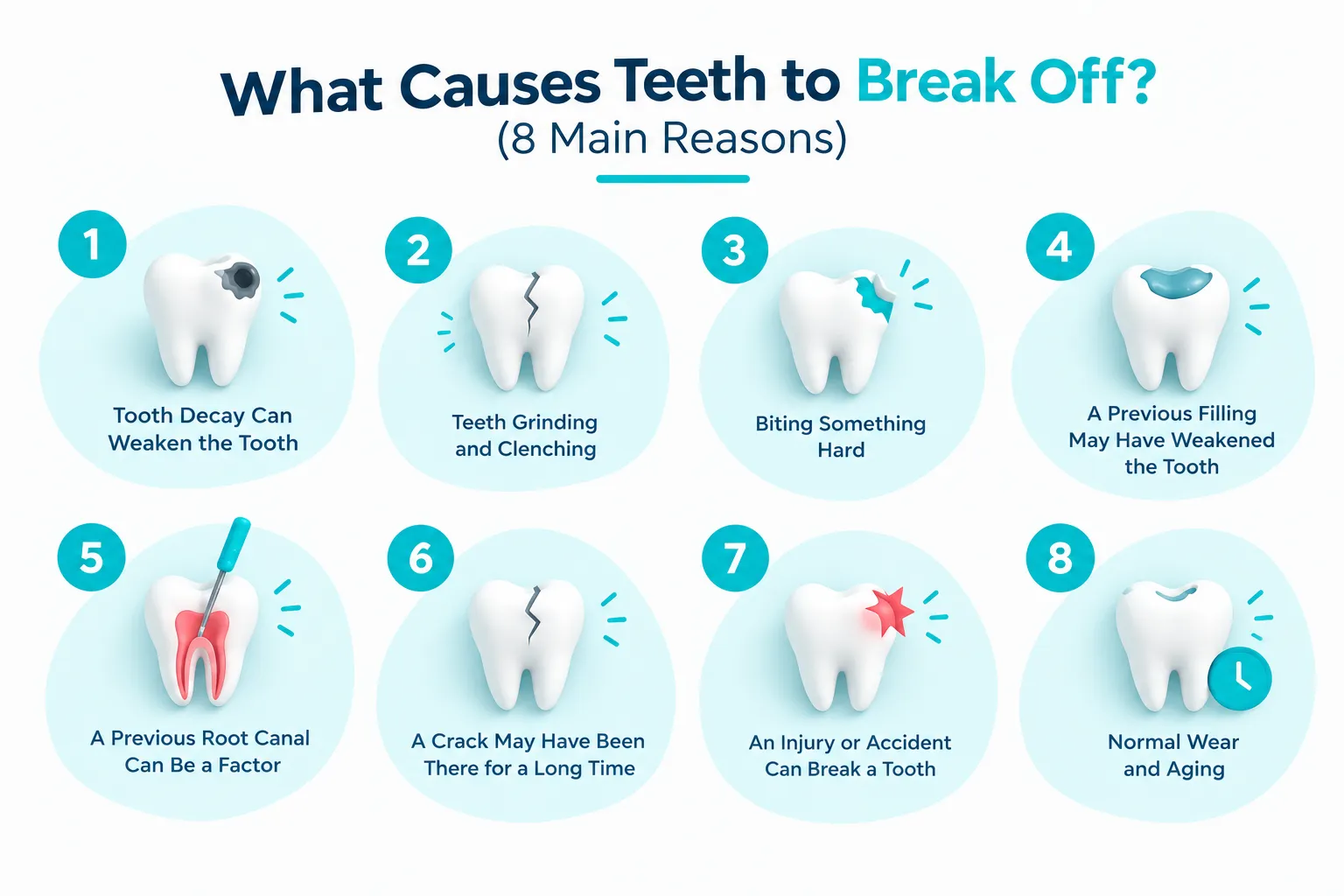
If your tooth broke and you're not sure why, you're in the right place. What causes teeth to break off is often a mix of small problems adding up over time. Let's look at the 8 main reasons:
Ever had a tooth break while eating something soft, and you wondered, "How did that happen?" → Tooth decay is usually the answer.
That's why a tooth can seem to break "out of nowhere."
What makes it worse is that decay is often silent at first (No pain, no warning). By the time you feel sensitivity or a toothache, the damage is usually well underway.
If you ever wake up with a sore jaw or a headache, you might be grinding your teeth in your sleep without even knowing it.
Grinding and clenching put constant pressure on your teeth. Night after night, that pressure wears them down and weakens them. Eventually, small cracks appear, and those cracks can turn into full breaks.
Signs It Might Be Happening To You:
If your teeth keep chipping or breaking with no clear cause, a dentist in Raleigh can tell you whether grinding is behind it and whether it's what makes teeth break off in your case.
Sometimes the explanation really is simple: something hard put too much force on the tooth, and it broke.
Everyday examples include:
The American Association of Endodontists recommends avoiding chewing on hard objects such as ice and unpopped popcorn kernels, as they can contribute to cracked teeth.
However, if a tooth breaks while eating something soft, that means the tooth was already weak, not the food.
Think of it this way: the bigger the filling, the less of your natural tooth is left to hold everything together.
That's why dentists often recommend a crown for heavily filled teeth, not just to cover them, but to protect what's left.
A root-canaled tooth may need extra protection, depending on how much of the tooth is left and where it sits in your mouth.
But let's not turn this into "root canals make teeth break." That's not accurate. What really matters is how much healthy tooth structure is left, how the tooth is used, what kind of restoration it has, and how much pressure it takes.
Your dentist can tell you whether a crown or another restoration is the right move.
Here's something most people don't realize: the piece that breaks off usually isn't where the problem began.
What causes teeth to crack and break off often starts small: a tiny crack forms in the tooth and slowly grows bigger with every chew. One day, part of the tooth breaks away.
This is why it's a good idea to have a cracked or broken tooth checked, even if the pain is mild or there's no pain at all.
A direct hit to the mouth can chip or fracture a tooth.
Common Causes:
If your tooth broke after an injury, keep in mind that what you see isn't always the full picture; your dentist may need to check the tooth, surrounding tissues, and pulp to find out how far the injury goes.
Your teeth work hard every day, and they've been doing it for years.
As you get older, all that wear adds up, making cracks and breaks more likely. But that doesn't mean breaking teeth is just a normal part of aging.
It means an older tooth has been through a lot — years of chewing, fillings, small cracks, and other changes. All of that can make it weaker and easier to break.
If you're wondering what causes teeth to break off while eating something soft, here's the truth: the food itself usually isn't the real cause.
A Tooth Can Already Be Weakened By:
So if a tooth breaks while you're eating something soft, remember that the tooth was already weak; that bite was just the final straw.
You Should Arrange A Dental Examination If You Notice:
One more thing: cracked teeth don't always hurt all the time. The pain may come and go when you chew, or you may only feel it with hot and cold foods.
It depends on the severity of the break.
A small chip usually isn't an emergency. But a badly fractured tooth, severe pain, swelling, bleeding, or any injury involving significant facial trauma needs prompt dental care. This is where emergency dentistry comes in.
And if the tooth broke after an accident (especially with severe pain, swelling, uncontrolled bleeding, or other facial injuries), seek urgent professional help right away.
Until You Can See Your Dentist:
At New Wave Dental Clinic, we'll examine your tooth, find out how deep the damage goes, and recommend the right treatment — whether it's a simple fix, tooth extractions, or something more.
Don't wait until it gets worse. A small break today can become a bigger problem tomorrow.
📞 Book your appointment at New Wave Dental Clinic today
What causes teeth to break off is usually not just one thing.
Sometimes it's clear — an accident or biting something hard. But most of the time, the tooth was already weak. Decay, an old crack, grinding, a big filling, past dental work, or years of wear.
So if your tooth breaks, don't try to guess why — you can't always see the real problem, and only a dental exam can tell you if the damage is on the surface or deeper, so the sooner you get it checked, the more options your dentist has to save it.
A tooth can absolutely break without any pain, especially if the crack hasn't reached the nerve yet.
No, a broken tooth can't grow back; unlike bone or skin, teeth don't repair themselves, so you'll need a dentist to fix it.
Repeatedly broken or chipped teeth may be related to decay, grinding or clenching, existing cracks, large fillings, previous dental treatment, trauma, or other factors that weaken tooth structure.
Teeth breaking in small pieces usually means they've been weakened over time by decay, grinding, old fillings, or enamel wear, so the tooth keeps losing small bits instead of breaking all at once.
If a tooth breaks during normal eating, it may already have been weakened by decay, a crack, a large filling, grinding, or previous damage. The food you were eating may simply have provided the final force that caused the weakened portion to break.
Yes. Once decay gets bad enough, it eats away at the tooth structure and leaves it weak and prone to breaking.
Yes. A broken or cracked tooth won't always hurt right away, but that doesn't mean it's fine. A dentist can check for more serious damage and let you know if treatment is needed.
Usually, yes. Depending on how bad the damage is, your dentist might use bonding, a filling, a crown, or a root canal. In severe cases, the tooth may need to be removed.
Not exactly. A small chip usually only affects the outer surface of the tooth, while a crack can go much deeper.
Teeth often break at the gum line because that's where the tooth is weakest — decay near the root, grinding, or a crack spreading downward can all cause it, and it usually needs a dentist's attention right away.
A piece of tooth usually breaks off because the tooth was already weak — from decay, a large filling, grinding, or a small crack that finally gave way.