One bite into something hard, and suddenly there's a jagged edge where your tooth used to be. You may be wondering: what can the dentist do for a broken tooth? The good news is that most breaks can be repaired. So, in this guide, we'll cover what the dentist checks, the treatments available, when you might need a crown, a root canal, or an extraction, and what it may cost.
Quite a lot. A dentist can rebuild the shape of the tooth, protect the nerve inside it, relieve pain, and stop bacteria from getting in. The treatment depends on how big the break is, where it is, and whether the inner part of the tooth (the pulp, which holds the nerve) is involved. A tiny chip may only need smoothing and polishing in one short visit. A larger break might call for bonding, a filling, or a crown. And in the less common cases where a tooth can't be saved, the dentist can remove it and replace it so you can chew and smile normally again.
Before choosing a treatment, the dentist needs to see what's really going on, and that goes beyond what shows in the mirror. Expect a few simple steps:
A dentist chooses a treatment based on how serious and large the damage is and where the tooth sits in your mouth. These are the main options:
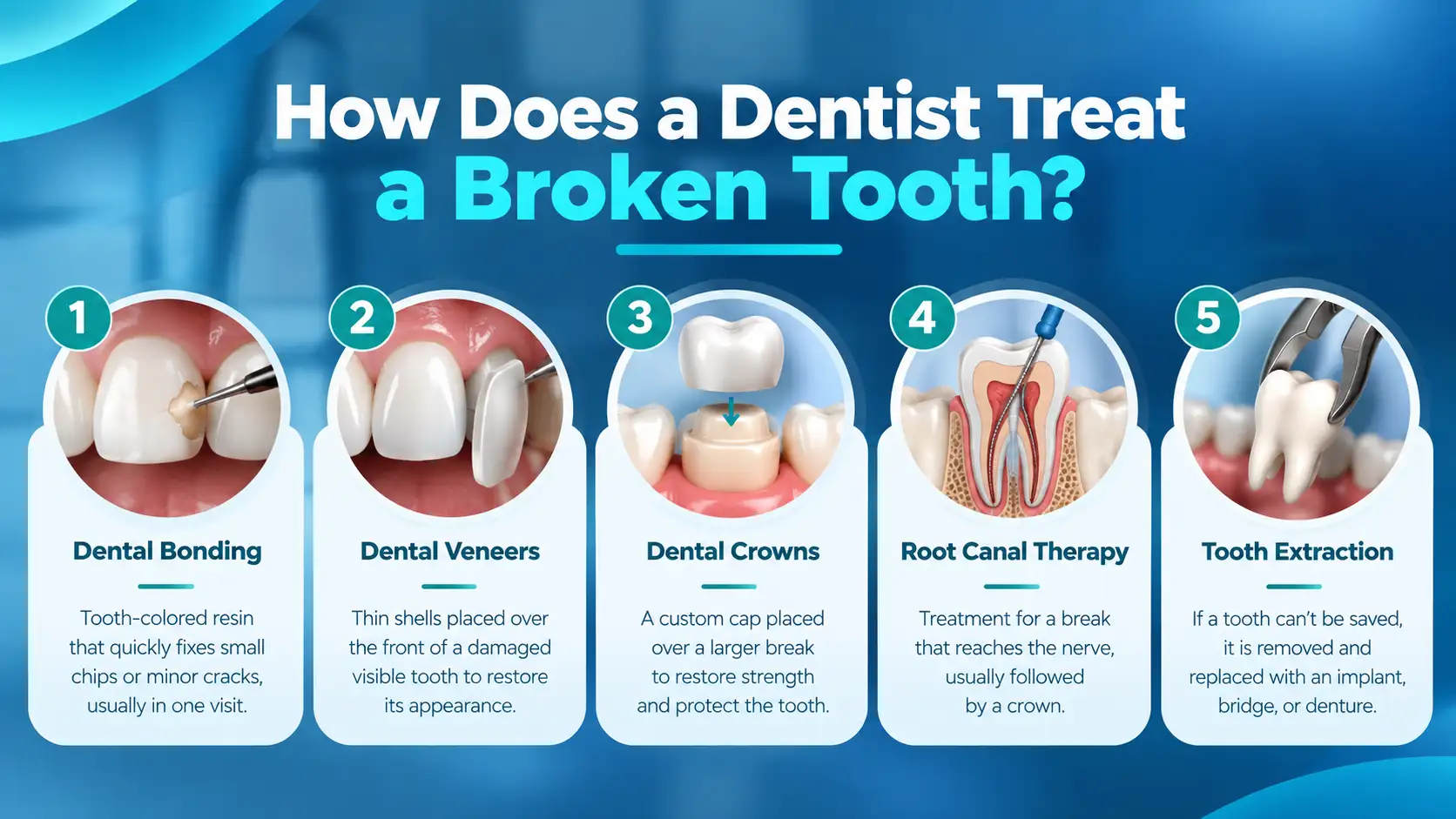
Yes, in most cases. If enough healthy tooth remains, a dentist can rebuild or cover it, and the sooner you go, the more of your natural tooth you can keep. This is one of the main reasons emergency dentistry exists: prompt care often means the difference between saving a tooth and losing it.
Often, yes. A tooth-colored composite filling rebuilds a small chip or minor crack and smooths the edge, usually in a single visit. When a large part of the tooth is missing, a filling isn't strong enough to handle chewing, so a crown is used instead.
A dental crown is a custom cap that covers the whole tooth, holding it together and restoring its strength. Dentists recommend one when about half or more of the tooth has broken away, when a cusp has fractured, when a crack hasn't split the tooth yet, or when a big old filling has left too little healthy tooth to support a new one.
A root canal is needed when the break reaches the pulp, the soft inner part of the tooth that holds the nerve, or when bacteria have caused an infection. The signs are throbbing pain, pain that lingers after hot or cold food, pain that wakes you at night, gum swelling, or a darkening tooth.
During the treatment, the dentist removes the damaged tissue, cleans and seals the inside of the tooth, and usually finishes with a crown. With local anesthesia, most people find it no more uncomfortable than a filling. Chips that don't reach the nerve don't need one.
Dentists try everything they can to save a tooth, but sometimes extraction is the safest choice. This is usually the case when a tooth has split into segments, when a crack runs down into the root, when the break extends well below the gumline, or when an infection can't be controlled.
Once the tooth is out, replacing it with an implant, bridge, or denture helps keep neighboring teeth from drifting and protects your bite.
So, what can the dentist do for a broken tooth? Quite a lot, but only if you don't wait too long. A broken tooth doesn't heal on its own, so waiting rarely helps, even if the pain fades. Bacteria can enter through the break and cause decay, chewing can spread a crack deeper toward the root, and an exposed nerve can lead to an abscess. You may also notice sensitivity to hot and cold, or a sharp edge that keeps cutting your tongue. Get urgent care if you have facial swelling, fever, pus, or severe pain.
Learn More About: Can a Broken Tooth Cause Problems?
The cost depends on the treatment. Smoothing and bonding usually cost the least, followed by fillings and crowns, while a root canal with a crown or an extraction with an implant costs the most. The tooth's location and your insurance coverage also play a part. An exam is the best way to get an accurate estimate, and treating a chip early almost always costs less than waiting. Once you know what can the dentist do for a broken tooth and what each repair involves, the cost conversation gets much easier.
If you're asking, what can the dentist do for a broken tooth? Our team at New Wave Dental will examine it, explain your options in plain language, and talk through costs before treatment begins. From small chips to deeper breaks, we offer bonding, crowns, and root canals, and we focus on your comfort at every step.
Call or visit us today to get relief and restore your smile!
So, what can the dentist do for a broken tooth? A dentist can repair a broken tooth using treatments like dental bonding, dental crowns, or a root canal, depending on how severe the damage is.
Yes. A general dentist can fix most broken or chipped teeth, including bonding, fillings, and crowns, and often root canals. For complex cases, such as a deeply infected nerve or a tooth that needs surgical removal, they may refer you to a specialist, like an endodontist or an oral surgeon.
Often, yes. A badly broken tooth can sometimes be saved with a root canal and a crown. If too little healthy tooth remains, the dentist can remove it and replace it with an implant, bridge, or denture.
It's uncommon, but it can happen, especially with teeth already weakened by decay, cracks, or large fillings. If it does, the dentist should assess the damage right away, explain what happened, and discuss the best way to repair or replace the tooth.